Apex Numismatics
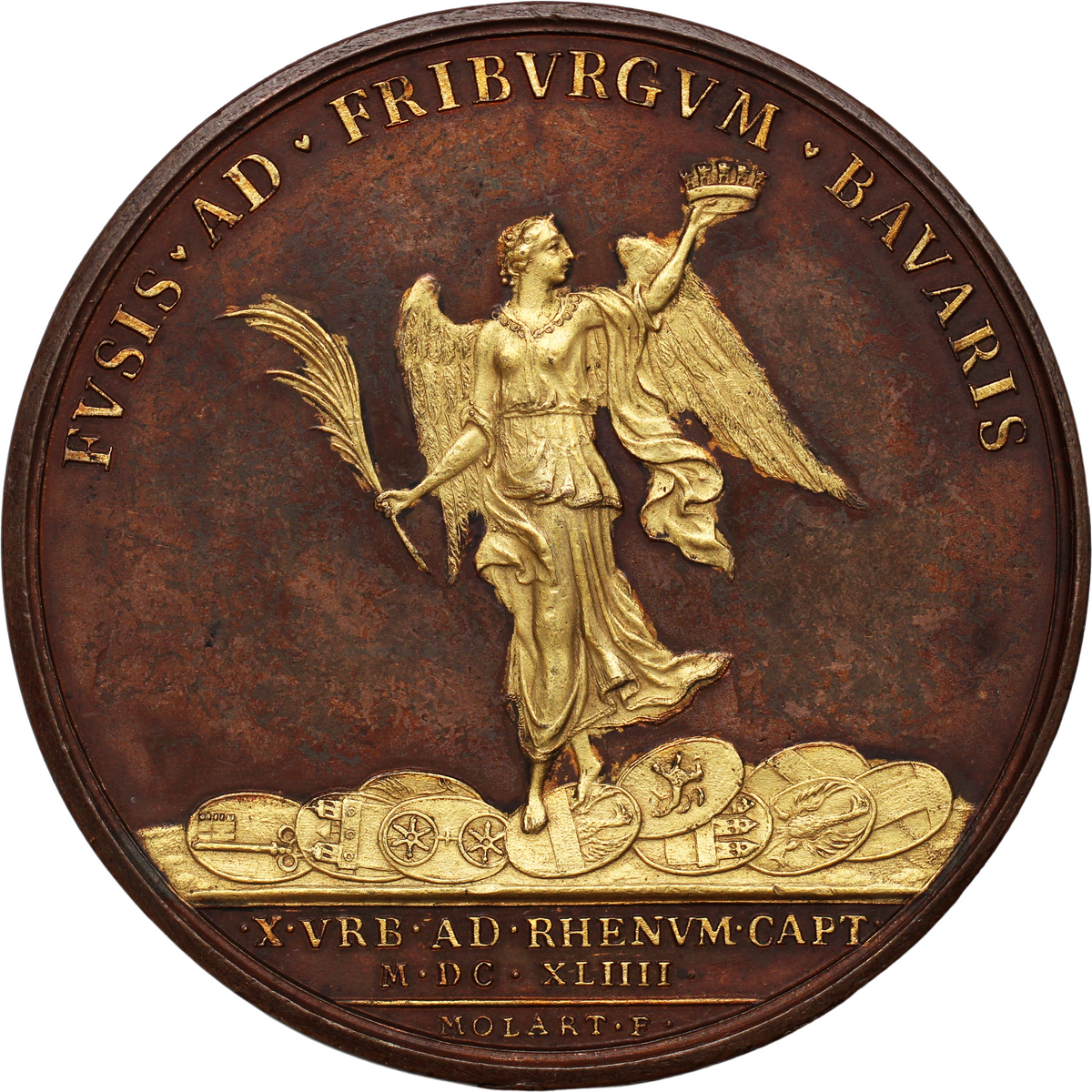
1644 France Louis XIV AE Damascened Medal on the Victory at the Battle of Freiburg
1644 France Louis XIV AE Damascened Medal on the Victory at the Battle of Freiburg
Couldn't load pickup availability
1644 France Louis XIV AE Damascened Medal on the Victory at the Battle of Freiburg, by M. Molart and J. Roettier. Plain edge.
LUDOVICUS XIV REX CHRISTIANISSIMUS, laureate underage bust right with cloak draped over his shoulders, signature R below || FVSIS AD FRIBVRGVM BAVARIS, Victory front, head turned right, holding a palm branch in her right hand and a crown in her raised left, standing upon the shield with coat of arms of the conquered cities along the Rhine. X VRB AD RHENVM CAPT MDCXLIIII, Molart F. below.
69.5mm, 130.94g. Divo -, Médailles françaises p. 32, No. 15 A. R. (bronze).
In uncirculated condition, with gilding intact. A few scattered marks, otherwise a choice example with gorgeous brown toning. An extremely rare type that has never been offered publicly as a damascened example.
Expertly damascened, a famed technique popular in the Baroque era, particularly in France. The raised surfaces have been carefully gilded in gold, creating a striking and beautiful bicolor appearance. These medals are extremely rare and were used as presentation pieces in the French Court.
The Battle of Freiburg and the subsequent French campaigns along the Rhine were a series of important French victories against the Habsburg-aligned forces of Bavaria during the Thirty Years War. Beginning on August 3rd and lasting until the 9th, French forces under the Duke of Enghien and Marshal Turenne successfully recaptured the city of Freiburg from Bavarian occupation under General Franz von Mercy. Following this victory, the French advanced along the Rhine, capturing the fortress of Philippsburg in September 1644, followed by Worms, Mainz, Landau, and other cities in the following months. These victories gave the French a considerable strategic advantage, allowing them to move troops unhindered into Germany and strengthening their position in the negotiations that resulted in the Peace of Westphalia four years later.
Share
Scroll to zoom · drag to move · double-click to reset