Apex Numismatics
1678 France Louis XIV AE Damascened Medal on the Capture of Léau
1678 France Louis XIV AE Damascened Medal on the Capture of Léau
Couldn't load pickup availability
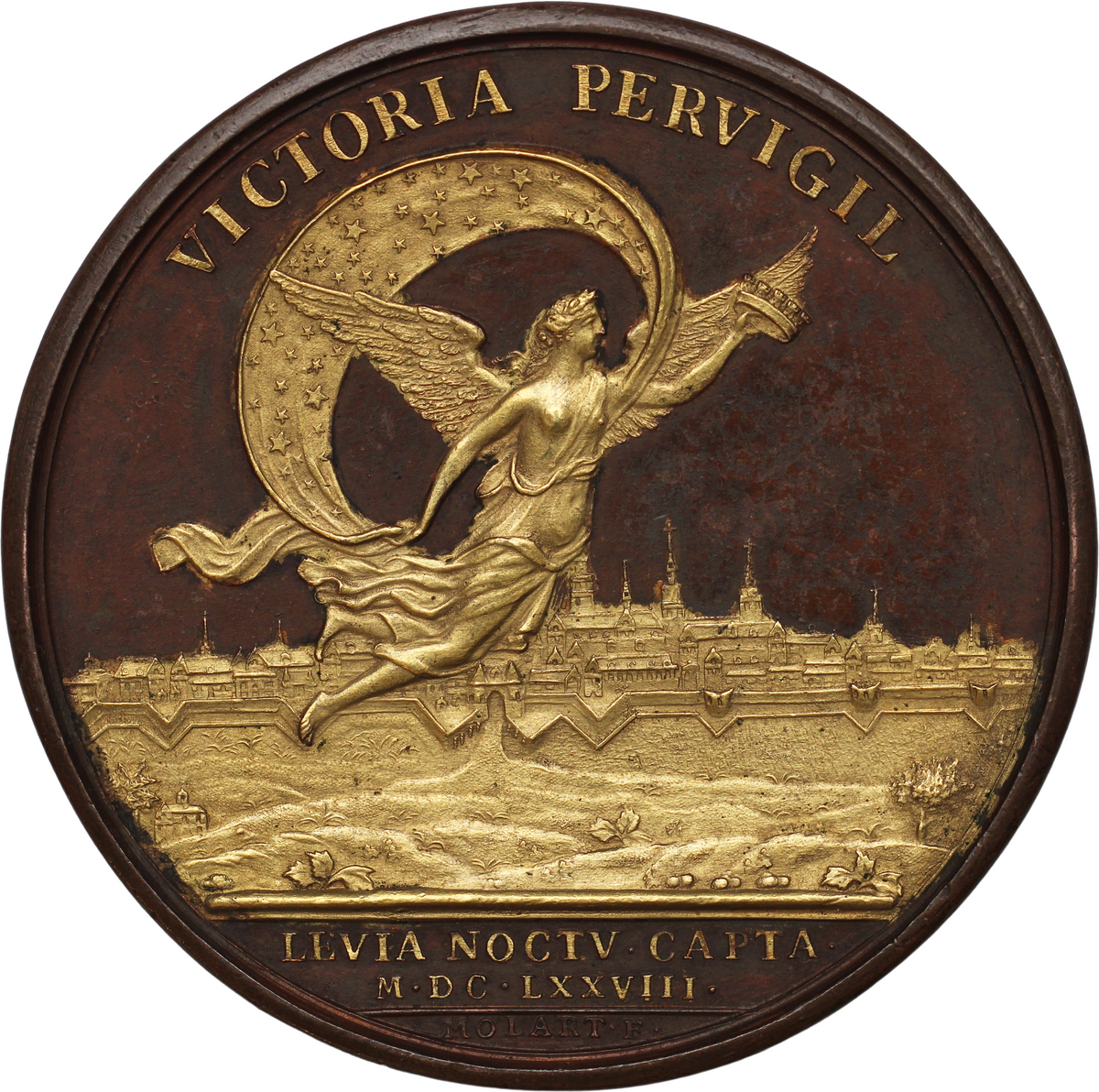
1678 France Louis XIV AE Damascened Medal on the Capture of Léau, by M. Molart and J. Roussel. Plain edge.
LUDOVICUS MAGNUS REX CHRISTIANISSIMUS, laureate armored older bust right, signature R below || VICTORIA PERVIGIL, Victory flying above the fortified town, shrouded in the veil of night and holding a mural wreath, LEVIA NOCTV CAPTA MOLART F in exergue.
71mm, 144.71g. Divo -, van Loon, - (cf. III, 229, 41 mm); Jacquiot, 396, II, pl. LXXV, 2.
In uncirculated condition, with gilding intact. Horizontal die crack across the bottom portion. Overall an extremely pleasing example with lovely chocolate brown surfaces. An extremely rare type that has never been offered publicly as a damascened example.
Expertly damascened, a famed technique popular in the Baroque era, particularly in France. The raised surfaces have been carefully gilded in gold, creating a striking and beautiful bicolor appearance. These medals are extremely rare and were used as presentation pieces in the French Court.
The Capture of Léau was a French victory during the final stages of the Franco-Dutch War. Léau was a town in Brabant, under the dominion of the Spanish Netherlands, situated along the Gete River. By 1678, Louis XIV’s campaign against Spain and her allies had proved largely successful, marked by the captures of several key cities. The King sought to capitalize on these victories and consolidate his military positions before the conclusion of peace negotiations which had already begun. Under the command of the Count of Calvo, the French infantry began their operation on the 4th of May, 1678, crossing the river and quickly attacking the town. Their speed succeeded in catching the garrison of Léau by surprise, with the town capitulating within the day. Though the capture succeeded in increasing pressure on Spain during the concluding months of the war, it was ultimately returned to Spain in 1678 as outlined under the terms of the Treaty of Nijmegen.
Share
Scroll to zoom · drag to move · double-click to reset