Apex Numismatics
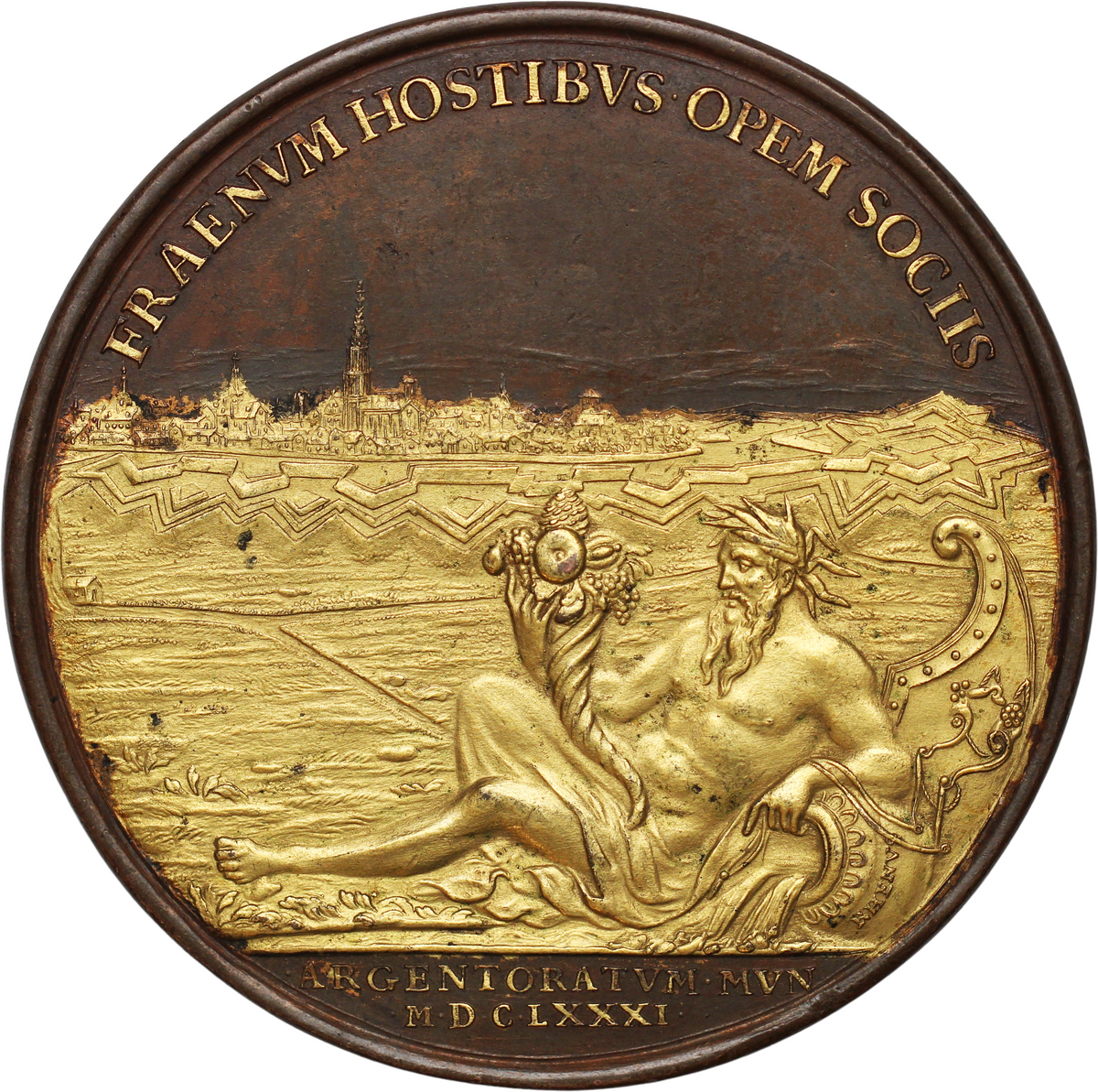
1681 France Louis XIV AE Damascened Medal on the Capture of Strasbourg
1681 France Louis XIV AE Damascened Medal on the Capture of Strasbourg
Couldn't load pickup availability
1681 France Louis XIV AE Damascened Medal on the Capture of Strasbourg, by J. Roettiers. Plain edge.
LUDOVICUS MAGNUS REX CHRISTIANISSIMUS, laureate armored older bust right, R below || FRAENVM HOSTIBVS OPEM SOCIIS, personification of the Rhine reclining left on urn, holding cornucopia, view of the fortified city of Strasbourg behind, ARGENTORATVM MVN MDCLXXXI below in exergue.
70mm, 151.51g. Divo -.
In uncirculated condition, with gilding largely intact. Horizontal die crack across the bottom portion. Overall an extremely pleasing example with lovely chocolate brown surfaces. An extremely rare type that has never been offered publicly as a damascened example.
Expertly damascened, a famed technique popular in the Baroque era, particularly in France. The raised surfaces have been carefully gilded in gold, creating a striking and beautiful bicolor appearance. These medals are extremely rare and were used as presentation pieces in the French Court.
The Capture of Strasbourg in 1681 was one of Louis XIV’s greatest territorial acquisitions. Following the Peace of Westphalia, France was granted extensive territory in Alsace, though the city of Strasbourg itself remained as an independent Free Imperial City under the control of the Holy Roman Empire. Upon the conclusion of the Franco-Dutch War, Louis sought to consolidate his control of Alsace, which would require taking the city of Strasbourg. The operation began in September of 1681, when 20,000 French troops surrounded the city and forced a surrender at the end of the month without significant military action. The city was then incorporated within the broader works in Alsace and served as a crucial crossing of the Rhine. Its fortifications were also reinforced, transforming the city into a major defensive stronghold in the East of France. Critically, the annexation was quite controversial as it was undertaken without a formal declaration of war, though it was later officially recognized as French territory under the Treaty of Ryswick in 1697.
Share
Scroll to zoom · drag to move · double-click to reset